
Why Pest Control and Health Department Standards Go Hand in Hand for Restaurants
Pest control and restaurant health department compliance are inseparable. If you run a food service business, here is what you need to know right away:
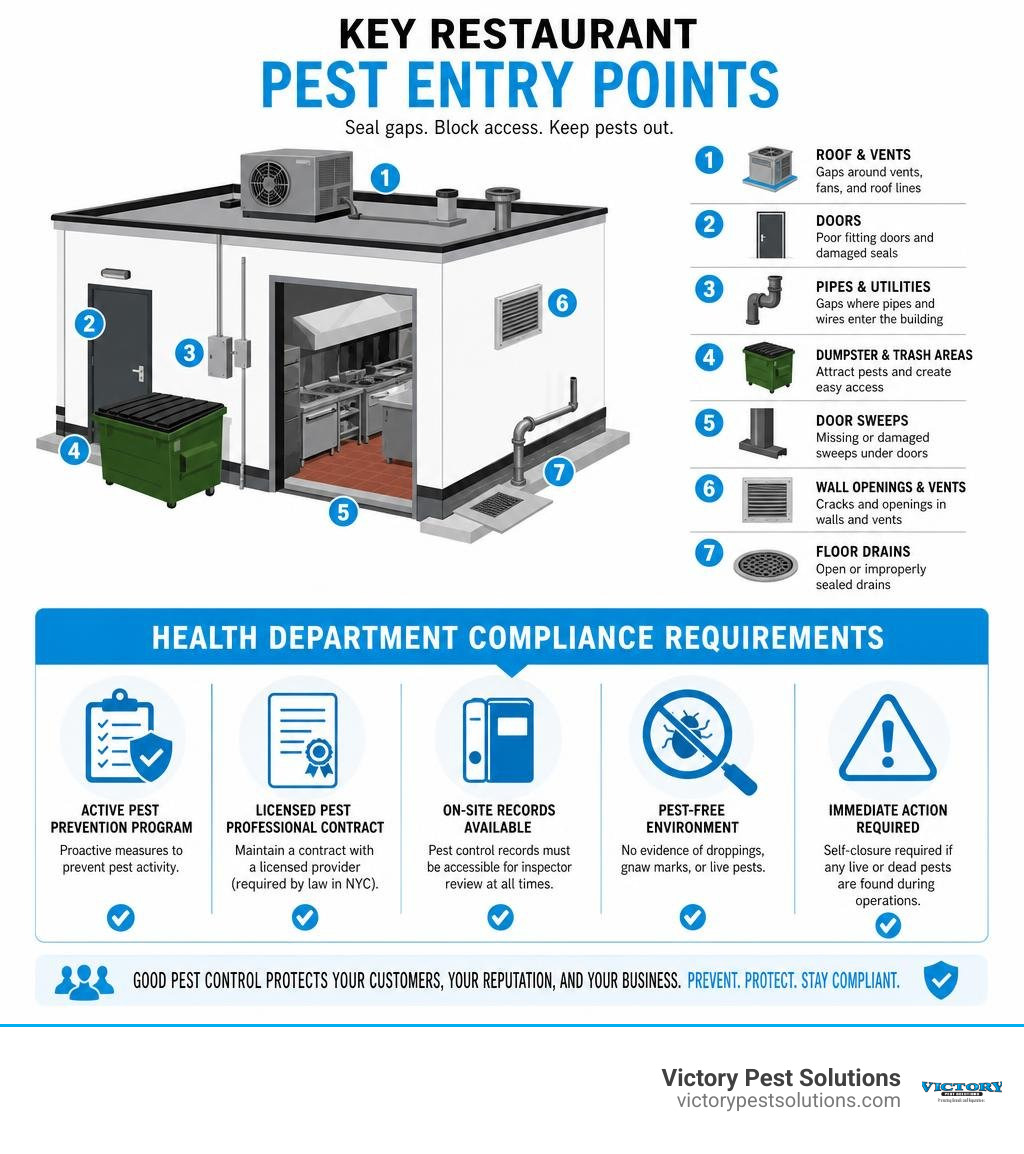
What health departments require for restaurant pest control:
- An active pest prevention program — not just reactive treatment
- A contract with a licensed pest management professional (required by law in NYC)
- On-site pest control records available for inspection at all times
- A pest-free environment, including no evidence of droppings, gnaw marks, or live pests
- Immediate self-closure if any live or dead pests are found during operations
A single cockroach or rodent sighting during an inspection can mean failed grades, fines, or a forced closure. That is not a worst-case scenario — it happens to restaurants every week.
The food, warmth, moisture, and shelter that make a kitchen great for cooking also make it attractive to pests. Cockroaches, rodents, and flies are not just a nuisance. They carry pathogens like Salmonella and E. coli that can sicken customers and land your restaurant on a public closure list.
I’m Len Oppenberg, founder of Victory Pest Solutions, and I’ve spent over two decades working in pest control for restaurant and health department-regulated environments across New York and beyond. In the sections below, I’ll walk you through exactly what inspectors look for, what documentation you need, and how to build a prevention program that keeps your facility compliant year-round.
The Role of the Pest Control Restaurant Health Department Connection
In the food service industry, regulatory compliance is your ticket to staying in business. Across our service areas, local health agencies hold the keys to your restaurant’s doors. In the five boroughs, the NYC Department of Health and Mental Hygiene (DOHMH) enforces strict sanitary codes. If you operate in Nassau County, the Health Department | Nassau County, NY – Official Website oversees food safety, while the Westchester County Department of Health manages the Safe Food – Westchester County Department of Health program to protect local diners.
These agencies exist to prevent foodborne illness outbreaks. Because pests are primary vectors for disease, health departments view pest activity as an immediate threat to public safety. To stay compliant, you must understand the NY Regulatory Pest Control Requirements for Restaurants that govern how commercial kitchens manage pest exclusion, sanitation, and professional treatment.
How the Pest Control Restaurant Health Department Inspectors Evaluate Your Facility
When a health inspector steps through your door, they are not just looking at food temperatures. They are actively hunting for pests and the conditions that attract them. Inspectors use high-powered flashlights to peer into dark, hidden areas, crouch down to inspect the spaces under heavy cooking lines, and examine the hard-to-reach areas behind dishwashers.
According to the NYC Health Department Pest Control Rules, inspectors look closely for:
- Live Pests: Any sighting of live roaches, mice, rats, or flies in food prep or storage areas.
- Evidence of Pests: Droppings, urine stains, gnaw marks, nesting materials, or grease rub marks along baseboards.
- Conducive Conditions: Standing water, grease buildup in drains, unsealed wall penetrations, and improperly stored food or garbage.
Missing even one hidden corner can lead to critical point deductions that ruin your inspection score.
Public Complaints and Pest Control Restaurant Health Department Investigations
Health inspections do not only happen on a routine schedule. In NYC, Westchester, and Nassau County, the public has a direct line to health authorities. If a customer spots a mouse scurrying across your dining room floor or a cockroach on the bar, they can easily file a complaint via 311 or online portals.
According to the official Information About Pest Control – NYC.gov: Business resources, the health department is obligated to investigate public complaints regarding sanitary conditions and pest infestations. A single public complaint can trigger an unannounced, rigorous inspection of your facility within days. This makes daily vigilance and proactive pest management essential.
Common Restaurant Pests and Their Public Health Risks
Restaurants are essentially a five-star resort for pests, offering an abundance of food, water, warmth, and hiding spots. However, when pests move in, they bring dangerous pathogens with them.

Pests carry bacteria like Salmonella, E. coli, Shigella, and Staphylococcus aureus on their bodies, legs, and in their digestive tracts. When they walk across prep tables, climb into clean pans, or feed on stored ingredients, they contaminate everything they touch. This contamination can cause severe food poisoning, leading to hospitalizations, lawsuits, and devastating damage to your brand’s reputation.
Cockroaches in Commercial Kitchens
German cockroaches are the most common and persistent insect threat in commercial kitchens. They love warm, humid areas near motors, ovens, and dishwashers. They are also master hitchhikers, frequently entering facilities hidden inside cardboard delivery boxes.
The reproductive rate of these pests is staggering. A single female German cockroach and her young can produce up to 300,000 cockroaches in just one year. Because they mature from egg to adult in about a month, a minor introduction can become a massive infestation before you know it. This is why immediate, targeted Cockroach Control Commercial Kitchens NYC is critical the moment a single roach is spotted.
Rodents and Flies
Mice and Norway rats are highly destructive pests that pose severe structural and health risks. Mice can squeeze through openings as small as a dime, while rats can enter through quarter-sized holes. Once inside, they chew through drywall, wires, and food packaging, leaving behind droppings and urine. Look out for the classic Signs of Rodent Infestation NYC Restaurants, such as dark smudge marks along walls, fresh gnaw marks, and distinct 1/4-inch (mouse) or 3/4-inch (rat) droppings.
Flies, particularly houseflies and drain flies, are equally dangerous. Houseflies feed on garbage and decaying matter, then land on fresh food, transferring pathogens via their saliva and feet. Drain flies breed in the organic slime that builds up inside dirty kitchen drains, making deep drain sanitation a key part of your pest defense.
Regulatory Compliance, Documentation, and Failed Inspections
Remaining compliant requires keeping meticulous records. When the health department visits, saying you have a pest control company is not enough—you have to prove it with paper or digital records.
| Record Type | Status | What Inspectors Look For |
|---|---|---|
| Pest Control Contract | Mandatory | A valid agreement with a state-licensed pest management provider. |
| Applicator Certification | Mandatory | Proof that the technician servicing your business is licensed by the NYS DEC. |
| Service Reports / Logs | Mandatory | Detailed reports of every visit, findings, and treatments used (kept for 12 months). |
| Pesticide Usage Records | Mandatory | Specific chemicals applied, application methods, and target pests. |
| Device Maps | Recommended | A layout map showing the exact locations of bait stations, traps, and monitors. |
| Daily Sanitation Checklists | Recommended | Internal staff logs showing daily cleaning of drains, grease traps, and trash areas. |
Is Monthly Pest Control Mandatory for NYC Restaurants?
A common question we hear is whether monthly pest control is legally required. While the health code does not explicitly dictate a “monthly” schedule, it does mandate that restaurants remain completely free of pests and have an active, professional prevention plan in place.
In practice, monthly service is the absolute industry standard for Restaurants Schedule Pest Control NYC compliance. Because of the high volume of food, moisture, and daily deliveries, waiting longer than a month between professional inspections invites disaster. High-risk or high-volume kitchens often require bi-weekly or even weekly visits to stay ahead of pest pressures.
Required On-Site Pest Control Records
During an inspection, you must immediately produce your pest control logbook. According to NYC PEST PROOFING guidelines, this logbook must contain your current service contract, the technician’s licensing credentials, and detailed service reports from the past 12 months.
Each service report must document:
- The date and time of the service.
- Specific areas inspected and any pest activity found.
- The corrective actions recommended to the restaurant owner.
- The exact treatments, baits, or traps utilized during the visit.
If you cannot produce these records on demand, the inspector can issue a violation, regardless of how clean your kitchen is.
What Happens When a Restaurant Fails a Pest Inspection?
Failing a pest-related health inspection is a costly nightmare. Depending on the severity of the findings, the health department can issue heavy fines, deduct critical points that drop your letter grade from an “A” to a “B” or “C”, or order an immediate temporary closure.

A closure occurs when an inspector finds an “imminent health hazard,” such as an active rodent infestation or widespread cockroach activity in food preparation areas. Experiencing an NYC Restaurant Failed Health Inspection means your doors are locked, a yellow “Closed” sign is posted on your front window, and your restaurant is listed on public health databases. The loss of revenue, combined with the damage to your reputation, can be difficult for any business to recover from.
Steps to Reopen After a Pest-Related Shutdown
If your facility is closed by the health department, you cannot simply clean up and reopen the next day. You must follow a strict, multi-step regulatory process to prove the hazard has been completely eliminated.
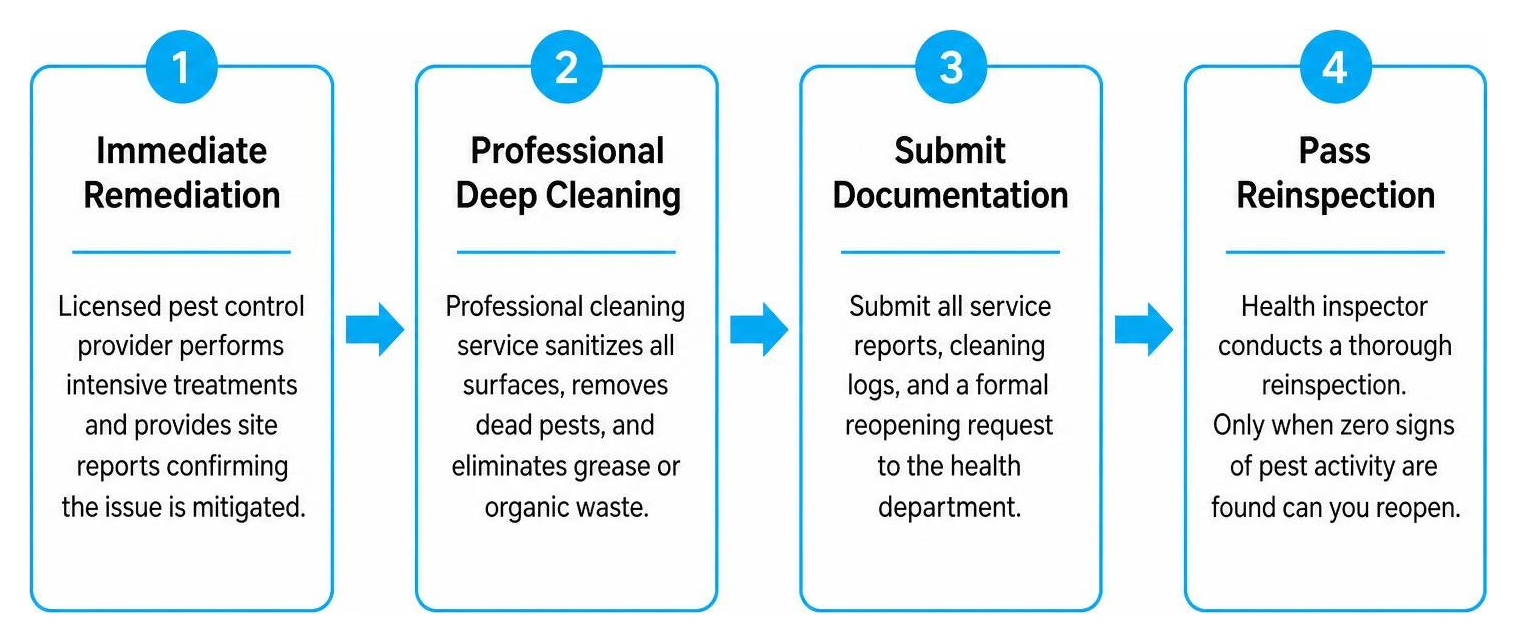
- Immediate Remediation: Your licensed pest control provider must conduct intensive treatments to eradicate the infestation and provide site reports confirming the issue is mitigated.
- Professional Deep Cleaning: You must hire a professional cleaning service to sanitize all surfaces, remove dead pests, and eliminate grease or organic waste.
- Submit Documentation: You must submit all service reports, cleaning logs, and a formal reopening request to the health department.
- Pass Reinspection: A health inspector will return to conduct a thorough, top-to-bottom reinspection. Only when they find zero signs of pest activity will you be allowed to reopen.
Failing to manage this process correctly can prolong your closure for weeks, which is why understanding NYC Restaurant Health Inspection Pest Failures and having an experienced partner is vital.
For example, in a widely reported case study, a popular restaurant was forced to remain closed for 11 days after inspectors found pests in food prep areas, as detailed in this report on how a North Side restaurant reopens after Metro Health shuts it down for pest infestation . This highlights how costly remediation delays can be without immediate professional intervention.
Implementing an Integrated Pest Management (IPM) Plan
The most effective way to stay compliant is by implementing an Integrated Pest Management (IPM) program. IPM is a holistic, science-based approach that focuses on long-term prevention rather than just spraying chemicals.
By combining rigorous sanitation, structural exclusion, routine monitoring, and targeted, low-toxicity treatments, Integrated Pest Management NYC Restaurants keeps kitchens pest-free while minimizing food safety risks.
Best Practices for Pest Prevention and Harborage Elimination
To keep pests from entering and nesting in your facility, your staff should follow these daily best practices:
- Install Door Sweeps: Ensure all exterior doors have heavy-duty, tight-fitting door sweeps. If light can shine through the bottom of a door, a mouse can walk right in.
- Seal Cracks and Crevices: Use silicone caulk or stainless steel mesh to seal gaps around plumbing penetrations, electrical conduits, and baseboards.
- Manage Garbage Properly: Keep all indoor trash cans covered. Clean outdoor dumpster areas daily, ensure the lids remain tightly closed, and wash down the concrete pad regularly.
- Practice Smart Food Storage: Store all dry ingredients in airtight, pest-proof plastic containers, kept at least six inches off the floor and away from walls.
- Inspect Deliveries: Train your team to inspect every incoming shipment of food and produce for signs of cockroaches or rodents before bringing them into the kitchen.
For a deeper dive into staff protocols, share our guide on Food Handlers Pest Management Prevention with your team.
Unenclosed Facilities and Special IPM Requirements
Operating an unenclosed food facility—such as a restaurant with large folding doors, open-air dining spaces, or roll-up windows—presents unique pest control challenges. Because these spaces are open to the outdoors, they are highly vulnerable to flies, birds, and rodents.
To operate legally without a full physical enclosure, local health departments require a specialized Integrated Pest Management and Food Safety Risk Mitigation Plan . This plan must outline proactive measures, such as air curtains (fly fans) above openings, strict timing on waste disposal, and immediate sanitation of tables.
For detailed compliance frameworks, operators should review the official guidelines on how to structure an INTEGRATED PEST MANAGEMENT AND FOOD SAFETY RISK MITIGATION PLAN FOR UNENCLOSED FOOD FACILITIES to keep open-air concepts compliant and pest-free.
Frequently Asked Questions About Restaurant Pest Inspections
Can a restaurant use sticky traps for pest control?
Yes, but only as monitoring tools within an Integrated Pest Management (IPM) program. Sticky traps are excellent for identifying the type and location of pest activity. However, they should never be left out indefinitely with dead pests on them, as health inspectors will write this up as a violation. Traps must be checked daily and replaced immediately once a pest is captured.
How do health inspectors score pest violations?
Pest violations are categorized as “critical” or “public health hazards.” Finding live rodents, fresh rodent droppings, or active cockroach infestations carries heavy point deductions (often 7 to 28 points per violation). Because NYC and local health departments operate on a point system where fewer points equal a better grade (0-13 points for an “A”), a single major pest violation can instantly drop your restaurant to a “B” or “C” grade, or trigger an immediate closure.
What is the most common entry point for restaurant pests?
The most common entry points are back doors left propped open during deliveries, gaps under doors lacking proper sweeps, utility penetrations (plumbing and electrical lines entering walls), and cardboard delivery boxes containing hitchhiking cockroaches or beetles.
Partnering with a Professional for Guaranteed Compliance
At Victory Pest Solutions, we understand that your restaurant’s reputation and livelihood depend on keeping the health department at bay. We specialize in providing premier, worry-free Restaurant Pest Control services designed specifically for the hospitality industry across New York City, Manhattan, Brooklyn, Queens, the Bronx, Staten Island, Westchester, and Nassau County.
We do not just react to pest problems; we prevent them. With our proactive IPM programs, 24/7 emergency support, and detailed, audit-ready digital documentation, we ensure your kitchen is always prepared for an unannounced inspection. Let us handle the pests so you can focus on serving your guests. Contact us today to schedule a comprehensive evaluation of your facility.