
An Essential Guide to Hospital Pest Control Requirements
What a Hospital Pest Control Checklist Must Cover
A pest control checklist for hospital use is a documented inspection tool that helps facilities find pest activity, remove conditions that attract pests, and show that corrective work was completed. It should cover patient safety, sanitation, building maintenance, sensitive clinical areas, food service, waste handling, and clear records for surveyors.
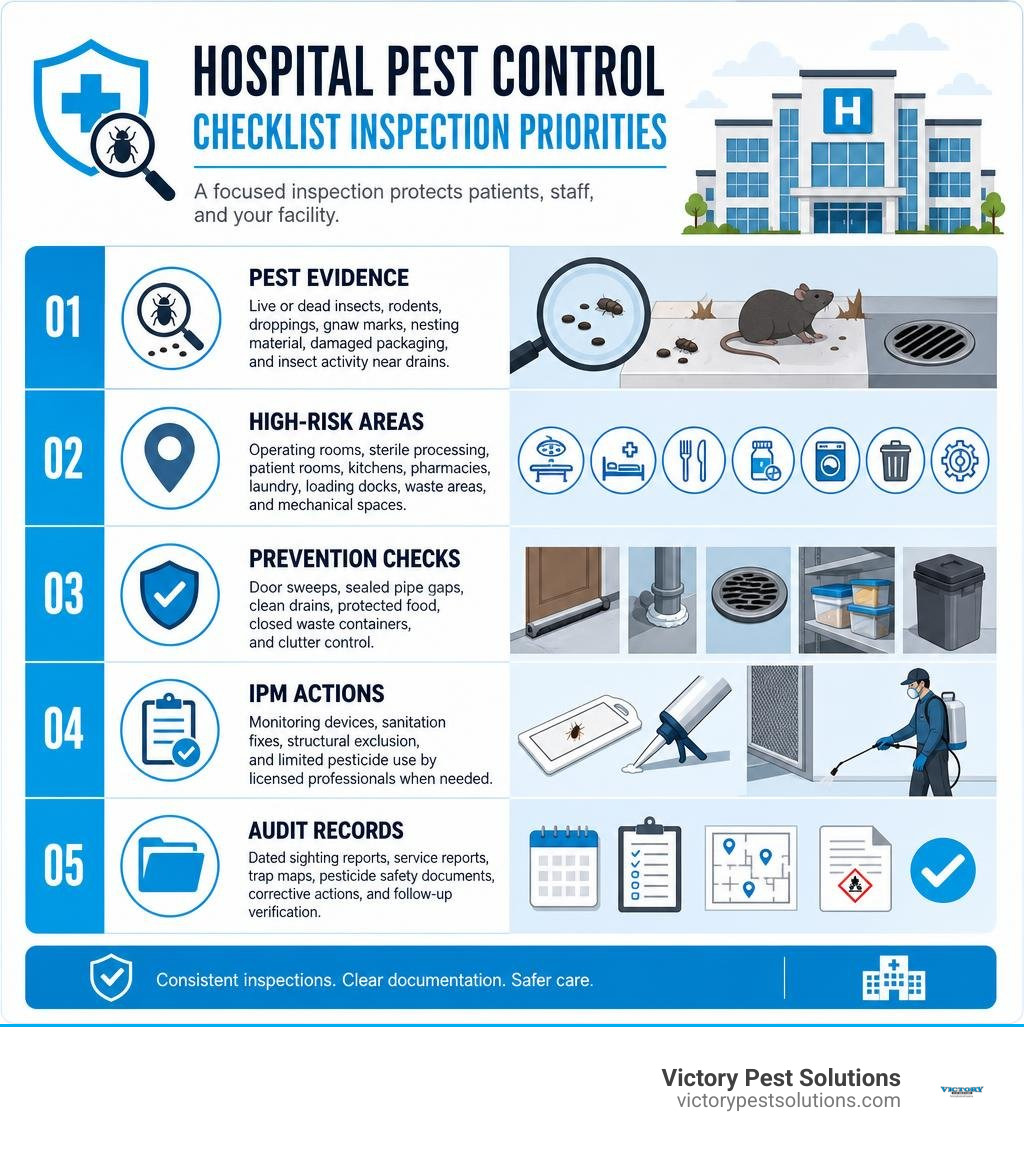
For a quick inspection, confirm that the checklist includes:
- Pest evidence: Live or dead insects, rodents, droppings, gnaw marks, nesting material, damaged packaging, and insect activity near drains.
- High-risk areas: Operating rooms, sterile processing, patient rooms, kitchens, pharmacies, laundry, loading docks, waste areas, and mechanical spaces.
- Prevention checks: Door sweeps, sealed pipe gaps, clean drains, protected food, closed waste containers, and clutter control.
- IPM actions: Monitoring devices, sanitation fixes, structural exclusion, and limited pesticide use by licensed professionals when needed.
- Audit records: Dated sighting reports, service reports, trap maps, pesticide safety documents, corrective actions, and follow-up verification.
In a hospital, pest management is more than a maintenance task. A single pest sighting near a surgical suite, medication storage area, or food service operation may require fast action because pests can contaminate supplies, disrupt care, and create serious compliance concerns.
I am Len Oppenberg, and I have worked in pest control since 2000, including specialized work with healthcare facilities before founding Victory Pest Solutions in 2007. My experience with urgent healthcare pest issues informs what a practical pest control checklist for hospital teams need to inspect, document, and escalate.
Regulatory Standards and Compliance for New York Hospitality Facilities
Healthcare facilities, medical centers, and hospital-adjacent hospitality properties across New York City and surrounding regions operate under strict regulatory scrutiny. Managing pest risks requires understanding how federal, state, and local standards intersect.
Hospitals and medical facility environments must comply with standards set by the Centers for Medicare & Medicaid Services (CMS), The Joint Commission (TJC), the Occupational Safety and Health Administration (OSHA), and local authorities such as the NYC Department of Health and Mental Hygiene. Meeting these requirements ensures patient safety, protects clinical integrity, and safeguards institutional reputation.
To ensure local health code compliance across New York City, facilities should routinely align their inspection protocols with established NYC Health Department Pest Control Rules.
NYC Health Code and Hospitality Standards
Local health authorities in New York evaluate facilities based on physical sanitation, structural integrity, and documented pest prevention protocols. Modern regulatory auditing has evolved significantly. Regulators no longer just look for physical traps; they demand verifiable, outcome-based timestamped evidence proving that pest management is actively maintained.
Documentation failures represent one of the most significant vulnerabilities during accreditation surveys. In fact, roughly 43% of citations issued by The Joint Commission stem directly from maintenance documentation failures rather than active infestations. A well-organized pest control checklist for hospital and healthcare environments provides the detailed paper trail required to verify that inspections occur consistently, vulnerabilities are identified, and corrective actions are documented promptly.
OSHA and FDA Guidelines for Hospitality Hygiene
OSHA enforces rigorous workplace safety standards that directly impact pest management. Under OSHA’s Hazard Communication Standard, facility managers must maintain up-to-date Safety Data Sheets (SDS) for all chemical formulations used on-site. The financial consequences of non-compliance are substantial: as of January 15, 2026, the maximum OSHA penalty for a serious violation reached $16,550.
Simultaneously, FDA food safety codes govern hospital dietary departments and commercial cafeterias. Food service operations within healthcare facilities must prevent contamination from mechanical vectors such as flies, cockroaches, and rodents, which can carry pathogens like Salmonella, E. coli, and Staphylococcus aureus.
Designing an Effective Pest Control Checklist for NYC Hotels
Creating an actionable pest control checklist for hospital and commercial facility use involves breaking down the property into distinct inspection points, risk categories, and observable signs of pest presence. A standardized checklist eliminates guesswork for facilities staff and environmental services (EVS) teams.
Key Physical Evidence and Signs of Pest Activity
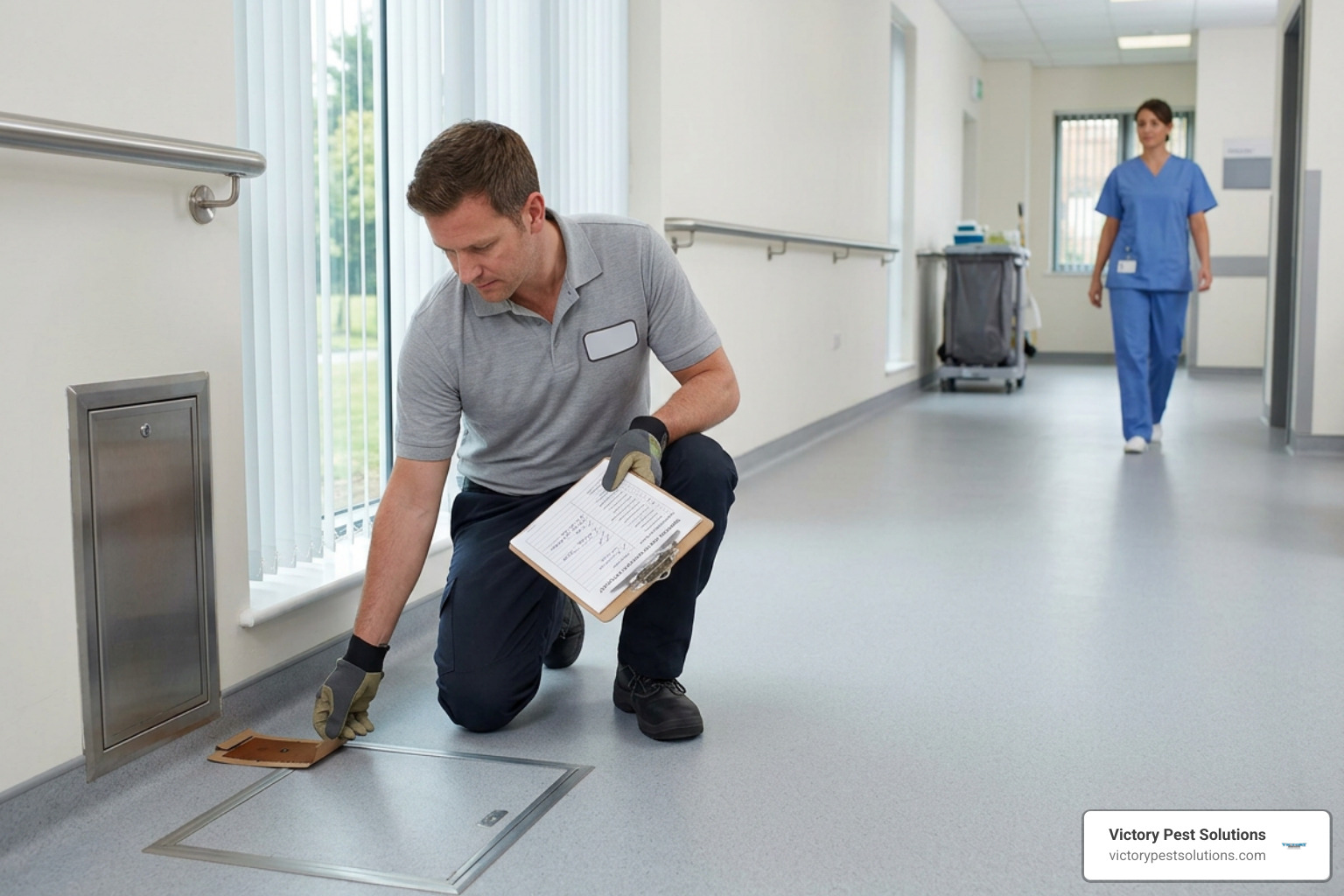
Inspectors and facility personnel must be trained to recognize early indicators of pest intrusion before an infestation becomes established. Key signs include:
- Droppings and Urine Stains: Small, rod-shaped droppings in dark corners or along baseboards indicate rodent activity. Cockroach droppings resemble small specks of black pepper or coffee grounds.
- Gnaw Marks and Structural Damage: Rodents gnaw continuously to trim their teeth, leaving visible marks on wooden pallets, plastic conduit, cardboard boxes, and door sweeps.
- Grease Smears and Rub Marks: Dark, oily residue along walls and baseboards points to established rodent runways.
- Nesting Materials: Shredded paper, insulation, fabric, or dry leaf debris hidden behind appliances or inside mechanical voids indicates active nesting.
- Live or Dead Insect Sighting: Finding live or dead beetles, flies, or bed bugs—or shed exuviae (skins)—warrants immediate investigation.
High-Risk Zones Covered in a Hotel Pest Control Checklist
Different areas within a medical or hospitality facility carry distinct risk profiles. A comprehensive checklist must tailor inspection protocols based on the sensitivity and function of each zone:
- Operating Rooms & Sterile Processing: Zero-tolerance zones requiring strict non-chemical exclusion, pristine air filtering, and sealed architectural voids.
- Patient Rooms & Guest Suites: Areas vulnerable to bed bugs or crawling insects introduced via personal belongings.
- Dining Facilities & Commercial Kitchens: High-moisture areas prone to German cockroaches and drain flies. Facilities should utilize specialized Commercial Insect Control Services to keep food prep zones clean and compliant.
- Pharmaceutical & Medical Supply Storage: Dry storage areas requiring strict moisture control and pest exclusion to protect sensitive medications and packaging.
- Loading Docks & Waste Compactor Pads: Primary entry vectors where shipping pallets and waste bins attract foraging rodents and flies.
Inspection Frequencies and Seasonal Pest Management
Pest pressures fluctuate throughout the year, demanding an adaptable inspection schedule. Implementing structured timelines ensures that routine maintenance catches minor issues before they turn into audit violations. Facilities managers can learn more about structuring routine visits by reviewing The Importance of Regular Commercial Pest Inspections.
Essential Inspection Frequency for Your Hotel Pest Control Checklist
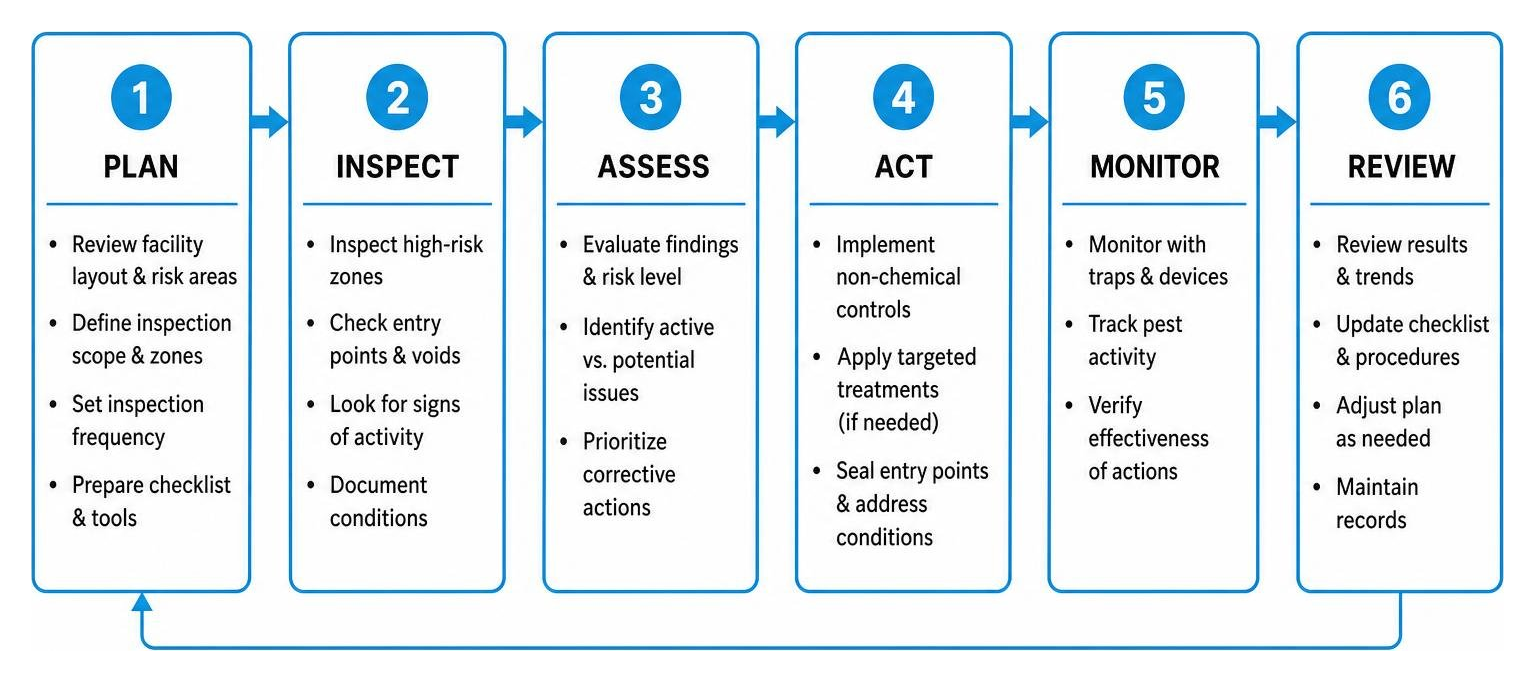
To maintain full compliance and operational safety, assign specific inspection frequencies across facility zones:
- Daily Checks: Conducted by EVS and housekeeping staff during routine cleaning. Focus on waste disposal areas, loading docks, and kitchen sanitation.
- Weekly Checks: In-depth evaluations of commercial food preparation zones, dishwashing areas, laundry facilities, and waste compactor pads.
- Monthly Checks: Structural assessments of administrative offices, mechanical rooms, basement utility tunnels, and building perimeter seals.
- Quarterly/Annual Reviews: Comprehensive facility audits conducted alongside licensed pest control professionals to review overall IPM performance, update trap floor plans, and audit documentation logs.
Seasonal Pest Mitigation and Overwintering Threats
New York’s dense urban environment subjects facilities to distinct seasonal shifts:
- Winter Rodent Pressures: As cold weather arrives, Norway rats and house mice seek warmth, shelter, and food inside heated mechanical tunnels, sub-basements, and utility penetrations. Structural exclusion—such as installing metal escutcheon plates and heavy-duty door sweeps—is essential. Facilities requiring specialized rodent mitigation can rely on professional Commercial Rodent Control Services.
- Summer Insect Surges: Warmer months bring increased mosquito activity around exterior grounds and entry points, while drain fly infestations surge in high-use food service areas. Maintaining proper drainage and applying biological drain treatments eliminates the organic biofilm where flies breed.
Integrated Pest Management (IPM) and Staff Empowerment
Modern healthcare and commercial facility pest control relies on Integrated Pest Management (IPM)—a proactive, multi-faceted approach that prioritizes long-term prevention over routine chemical spraying. IPM principles focus on habitat alteration, structural exclusion, physical monitoring, and sanitation.
| Pest Control Approach | Traditional Pest Control | Integrated Pest Management (IPM) |
|---|---|---|
| Primary Method | Scheduled, routine pesticide application | Environmental controls, exclusion, & sanitation |
| Pesticide Usage | Broad-spectrum chemical sprays | Low-volatility gels & containerized baits (last resort) |
| Focus Area | Reactive treatment after pest sighting | Proactive prevention & root cause removal |
| Staff Role | Passive; reliance on external technicians | Active; continuous staff reporting & involvement |
| Documentation | Basic service receipts | Detailed, timestamped logs & trend analysis |
In sensitive medical environments, chemical treatments are heavily restricted. When pest intervention becomes necessary, licensed applicators utilize containerized baits or low-volatility gel formulations in inaccessible locations to protect indoor air quality and patient health.
Housekeeping and Facilities Staff Training
Environmental services (EVS) and housekeeping personnel are a facility’s primary line of defense. Training staff to recognize early pest indicators transforms daily cleaning rounds into active monitoring opportunities.
Staff members should be taught to inspect key areas:
- Underneath sinks and behind ice machines for moisture leaks.
- Inside laundry carts and supply closets for insect activity.
- Along baseboards and door frames for structural entry gaps.
Providing simple observation forms or digital reporting tools empowers employees to log observations instantly, ensuring maintenance issues are resolved before pests establish themselves.
Interdepartmental Alignment for Pest Prevention
Effective pest management requires seamless coordination across hospital departments. Cleaning staff, food service managers, waste handling crews, and pest control technicians must operate in harmony.
Audit Readiness, Documentation, and Corrective Action Protocols
When surveyors from regulatory bodies or accreditation organizations inspect a healthcare facility, they scrutinize the centralized pest control logbook. An audit-ready logbook provides concrete proof of an active, effective IPM program.
Maintaining an Audit-Ready Pest Management Logbook
A centralized pest management logbook should be accessible to facility administrators and regulatory auditors at all times. It must contain:
- Pest Sighting Log: Timestamped records detailing the exact date, time, location, pest observed, and name of the reporting staff member.
- Service Reports: Detailed documentation from licensed pest control contractors outlining inspection findings, devices checked, and services performed.
- Trap Map & Floor Plans: Up-to-date schematics displaying the exact placement and numbering of all interior and exterior monitoring devices.
- Safety Data Sheets (SDS) & Labels: Complete chemical product labels and SDS documents for every formulation authorized for use on-site.
- Licensing Credentials: Valid proof of licensure and insurance for the external commercial pest control vendor.
Immediate Response and Corrective Action Workflow
When pest activity is identified within a facility, an immediate corrective workflow must be triggered:
- Isolation & Containment: If pests are spotted in a patient room or sensitive zone, temporarily isolate the space and suspend access until evaluated.
- Professional Inspection: Contact a licensed pest management provider to perform a thorough root-cause assessment.
- Targeted Non-Chemical Intervention: Implement physical exclusion, structural repairs, or deep cleaning to address the underlying cause.
- Document Corrective Action: Record the specific corrective measures taken in the centralized logbook.
- Follow-Up Verification: Schedule a follow-up inspection within 7 to 14 days to confirm that the issue has been completely resolved.
Frequently Asked Questions About Hotel Pest Control in NYC
What is the standard for pest control in NYC hotels and hospitality facilities?
The standard for pest management in NYC healthcare and commercial hospitality facilities is Integrated Pest Management (IPM). IPM emphasizes proactive structural exclusion, continuous physical monitoring, strict sanitation practices, and non-chemical pest prevention. Chemical applications are restricted to targeted, low-risk interventions carried out exclusively by state-licensed professionals.
How often should a Manhattan hotel perform pest control inspections?
Inspection frequencies depend on zone risk levels. High-risk areas like commercial kitchens, dietary preparation zones, waste compactor rooms, and loading docks require weekly or bi-weekly inspections. Patient care areas, guest suites, and administrative zones should undergo formal monthly inspections, supported by daily observational monitoring during staff cleaning routines.
Are chemical pesticides allowed in guest rooms and dining areas?
Routine broadcast chemical spraying is strictly prohibited in sensitive healthcare environments, patient rooms, and food preparation areas. If pest activity requires chemical intervention, licensed professionals apply low-volatility containerized baits, gels, or desiccant dusts strictly inside inaccessible structural voids, crack-and-crevice locations, or trap enclosures to safeguard indoor air quality and occupant health.
Partnering for Compliance and Operational Excellence
Maintaining a comprehensive pest control checklist for hospital and medical facilities is essential for patient health, regulatory compliance, and audit readiness. By combining proactive Integrated Pest Management principles with meticulous record-keeping and interdepartmental coordination, facility managers can eliminate pest vulnerabilities before they impact operations.
At Victory Pest Solutions, we specialize in providing commercial pest management tailored to healthcare, hospitality, and institutional facilities across New York City and surrounding metro areas. From 24/7 emergency response to audit-ready digital documentation, our team ensures your facility remains compliant, hygienic, and secure. Explore our specialized Healthcare Pest Control services today to keep your operations running safely and smoothly.