
A Practical Guide to Fly Control
Why Fly Control Is a Serious Business Problem for NYC Hotels and Restaurants
Fly control is the process of preventing, reducing, and eliminating fly infestations using a combination of sanitation, exclusion, trapping, and targeted treatments. Here is a quick overview of the most effective methods:
- Sanitation first – Remove breeding sources like food waste, standing water, and organic buildup in drains
- Exclusion – Seal entry points with 18-mesh screens, door sweeps, and air curtains
- Trapping – Use UV glue board traps near entry points and away from food prep surfaces
- Biological controls – Parasitic wasps and beneficial nematodes target fly larvae without chemicals
- Chemical treatments – Residual sprays and insect growth regulators used as a last layer, rotated to prevent resistance
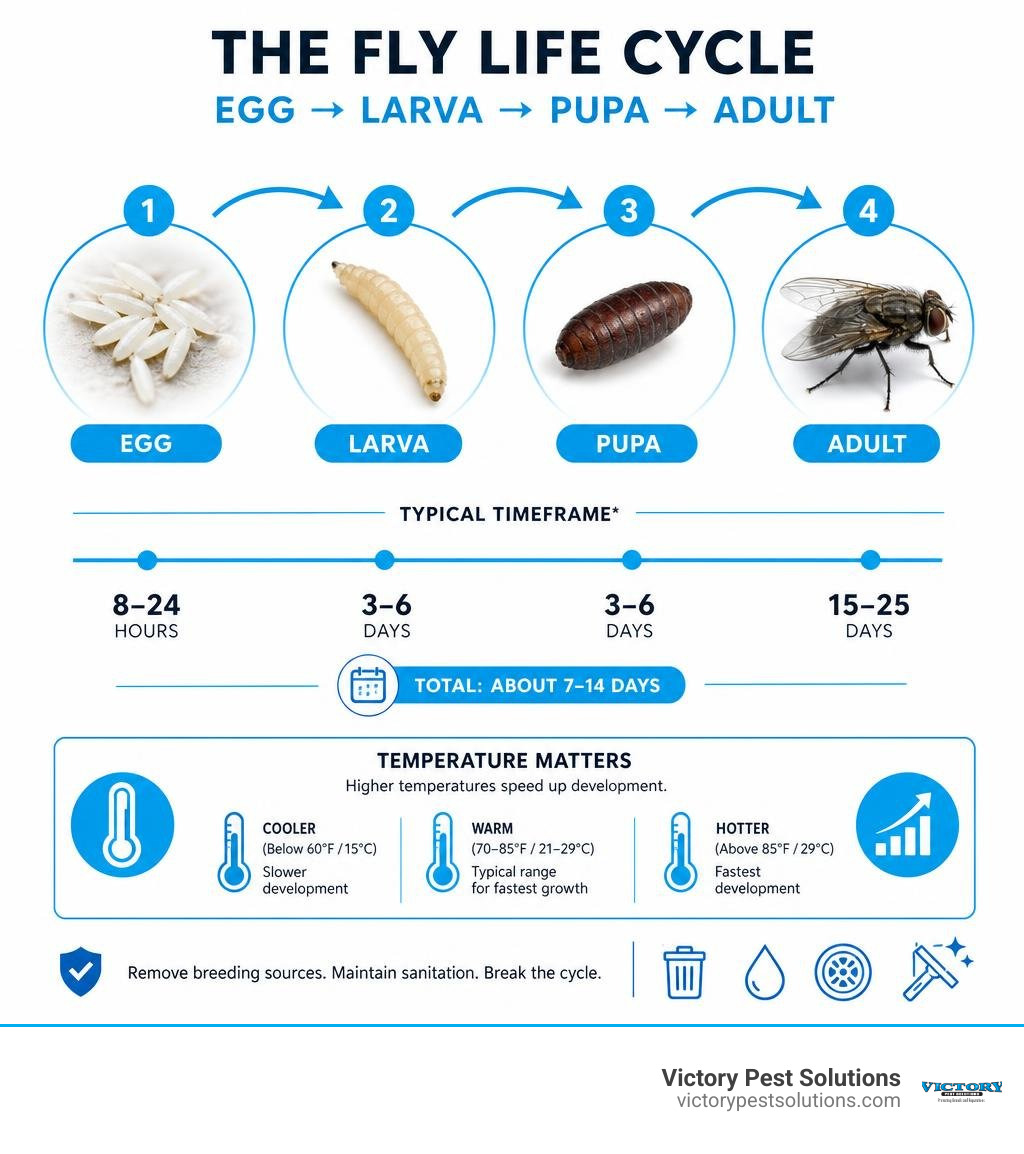
Flies are more than a nuisance in a hotel or restaurant. A single house fly can carry over 20 diseases — including Salmonella and E. coli — picking up pathogens from waste and depositing them directly onto food surfaces and prep areas. And they multiply fast. Under warm conditions, a fly can go from egg to adult in as little as seven days. One fly problem left unchecked can become hundreds within weeks, threatening your health department rating, your guests’ experience, and your business’s reputation.
I’m Len Oppenberg, founder of Victory Pest Solutions, and I’ve spent years specializing in fly control for commercial facilities including food service, healthcare, and hospitality businesses across New York. In the sections below, I’ll walk you through exactly what works — and what doesn’t — so you can protect your operation before a small fly problem becomes a crisis.
Understanding the Enemy: Common Fly Species in NYC Hotels

To defeat your enemy, you first have to know who they are. In the dense, environment of Manhattan and the surrounding boroughs, hotels and restaurants face a unique mix of fly species. Each of these pests has its own preferred breeding ground, feeding habits, and structural entry points. Understanding these differences is the first step in designing an effective fly control program.
The common house fly (Musca domestica) is a frequent invader in loading docks, dumpster areas, and commercial kitchens. These flies are dull gray, about a quarter-inch long, and have four distinct dark stripes behind their heads. Because they feed on rotting organic matter, animal waste, and garbage, they carry millions of bacteria on their legs and mouthparts. When they land on a prep table or a guest’s plate, they immediately transfer these pathogens.
Other frequent offenders include blow flies and bottle flies, which are easily recognized by their metallic green or blue sheen. These flies are heavily attracted to decaying animal matter and garbage. If you suddenly see a swarm of bottle flies in a hotel hallway, it often points to a dead rodent trapped behind a wall or a severely neglected trash chute.
According to scientific research on Common Household Flies and Prevention, understanding the biology and specific breeding preferences of these insects is the only way to achieve long-term control. Without identifying the species, you might waste time treating the drains when the real source is a dumpster down the block.
The Proliferation of Fruit Flies in Dining Areas
If you operate a hotel bar in Tribeca or a buffet line in a Midtown hotel, you are likely all too familiar with the dreaded fruit fly. These tiny, 1/8-inch-long pests with bright red eyes have a near-supernatural ability to find fermenting organic matter.
Fruit flies do not just hang around fruit bowls. They thrive in:
- Beer taps and drip trays
- Soda fountain nozzles
- Trash cans containing discarded cocktail garnishes
- Sinks with slow-moving drains
Because they reproduce at an alarming rate—a single female can lay hundreds of eggs in her brief lifetime—a minor spill behind the bar can trigger an outbreak that ruins a guest’s dining experience. When fruit flies start hovering around your customers’ wine glasses, it is time to implement targeted fruit fly control services to locate the exact breeding source and eliminate it.
Drain Flies and Phorid Flies in Commercial Restrooms
Step into a commercial restroom or a basement dishwashing station, and you might encounter drain flies or phorid flies. Drain flies (also known as moth flies) are fuzzy, moth-like insects that breed in the gelatinous organic slime that coats the inside of dirty drains and sewer lines. They do not fly well, often hopping along walls near sinks and floor drains.
Phorid flies (or humpbacked flies) look similar to fruit flies but lack the red eyes and have a distinct humpbacked appearance. Phorid flies are particularly insidious because they breed in deep organic filth, including cracked sewer lines beneath concrete slabs. If a pipe leaks beneath your hotel’s basement floor, phorid flies can breed in the saturated soil and emerge through tiny cracks in the tile.
Managing these pests requires deep sanitation and specialized foaming treatments. If you want to keep your dining rooms and restrooms pristine, learning how to keep fruit flies out of your restaurant and managing your drains effectively is absolutely essential.
Integrated Fly Control Strategies for Manhattan Hospitality Businesses

Relying solely on chemical sprays to solve a fly problem is like using a bucket to bail out a leaking boat—you are treating the symptom, not the cause. To achieve true control in busy commercial environments, we utilize Integrated Pest Management (IPM). IPM is a holistic approach that combines structural exclusion, rigorous sanitation, mechanical trapping, and the highly targeted use of pesticides only when necessary.
Sanitation is the absolute foundation of any IPM program, accounting for up to 75% of fly prevention success. If you eliminate the food, water, and breeding sites that flies need to survive, the population will naturally collapse. This means setting up strict daily cleaning protocols:
- Power-washing dumpsters and keeping lids tightly closed.
- Cleaning mops and storing them head-up so they dry completely.
- Removing standing water from basement floors and utility closets.
- Flushing floor drains with enzymatic cleaners to break down organic buildup.
According to a comprehensive A Review of Alternative Controls for House Flies – PMC, relying on non-chemical, physical, and biological methods is highly effective, especially in sensitive environments like commercial kitchens and healthcare facilities where traditional chemical applications are highly restricted.
Physical Barriers and Exclusion for Fly Control
Before you can eliminate flies inside your hotel, you must stop them from getting in. In a bustling city like New York, doors are constantly opening for guests, luggage, and food deliveries. This is where mechanical exclusion techniques become your best friend.
One of the most effective tools for busy entrances is the air curtain (or air door). When mounted over a doorway, these units blow a continuous stream of high-velocity air downward. Flies, which are relatively weak flyers, cannot penetrate this air barrier. Interestingly, research shows that air curtains mounted vertically on the sides of doors can achieve 98% to 100% house fly exclusion at lower velocities than traditional overhead units.
Additionally, installing high-quality, intact 18-mesh screens on all windows and kitchen doors is vital. This mesh size is small enough to exclude not only large house flies but also smaller biting insects. Ensuring that all exterior doors have heavy-duty, tight-fitting door sweeps and maintaining positive air pressure within the building—so air blows out when doors open rather than sucking flies in—are key structural defenses.
Chemical vs. Biological Methods for Fly Control
When physical exclusion and sanitation are not quite enough, we look at active suppression methods. Homeowners and agricultural managers often have to choose between traditional chemical insecticides and biological controls.
Traditional insecticides include residual surface sprays, space sprays (aerosols), and toxic baits. Residual sprays are applied to vertical surfaces where flies like to rest, such as walls near loading docks. However, flies can quickly develop resistance to these chemicals. To prevent this, pest management professionals must constantly rotate the active ingredients they use.
On the other hand, biological controls use nature to fight nature. In agricultural or outdoor settings, this often involves releasing beneficial nematodes or parasitic wasps. Parasitic wasps are tiny, non-stinging insects that lay their eggs inside fly pupae, destroying the developing fly before it can hatch. Beneficial nematodes are microscopic worms applied to soil or compost to hunt down and consume fly larvae.
While biological controls are fantastic for farms, stables, and compost sites, they are rarely used inside a Manhattan hotel kitchen for obvious reasons—guests do not want to see any insects, even beneficial ones! For indoor commercial spaces, we rely on a carefully balanced mix of physical exclusion, non-toxic traps, and highly targeted, food-safe chemical applications like Insect Growth Regulators (IGRs), which disrupt the fly’s life cycle without posing a risk to humans or pets. You can learn more about these balanced approaches in the Purdue University extension guides on integrated pest management.
Comparing Fly Traps: Sticky, Bait, and UV Light Systems
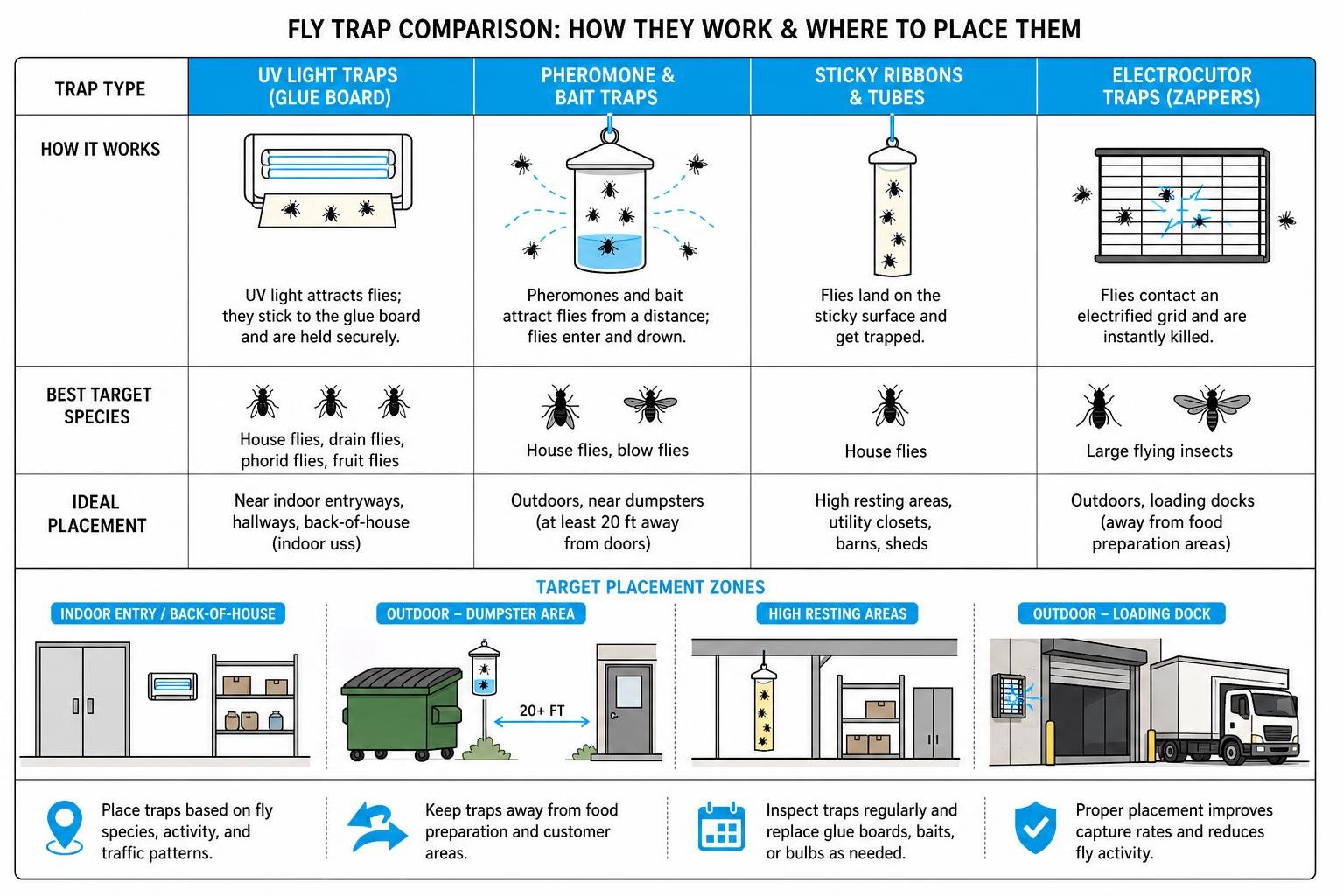
Choosing the right trap depends entirely on the type of fly you are targeting and where the trap will be placed. A trap that works wonders on an outdoor loading dock could cause a disaster if hung inside a restaurant dining room.
| Trap Type | Best Target Species | Ideal Placement | Pros | Cons |
|---|---|---|---|---|
| UV Light Traps (Glue Board) | House flies, drain flies, phorid flies, fruit flies | Near indoor entryways, hallways, back-of-house | Silent, hygienic, captures and holds insects securely | Requires regular bulb and glue board replacement |
| Pheromone & Bait Traps | House flies, blow flies | Outdoors, near dumpsters (at least 20 feet away from doors) | Highly attractive over long distances | Extremely smelly; can actually draw flies toward your building if placed poorly |
| Sticky Ribbons & Tubes | House flies | High resting areas, utility closets, barns | Cheap, easy to install | Visually unappealing; dry out quickly in dusty environments |
| Electrocutor Traps (Zappers) | Large flying insects | Outdoors, loading docks (away from food) | High capacity, instant kill | Disperses insect body fragments; noisy “zapping” sound |
Why Glue Board UV Traps Outperform Electrocutors
For indoor commercial spaces—especially those governed by strict health codes—glue board UV traps are vastly superior to traditional electrocutor “zappers.”
When a fly hits an electrocutor grid, the electric shock literally explodes the insect. This explosion can disperse pathogen-contaminated body parts and microscopic airborne particles up to several feet from the trap. If that zapper is located anywhere near a food preparation line, buffet, or dining table, those contaminated particles can land directly on food or clean plates, violating FDA food safety regulations.
Glue board UV traps, by contrast, use specific wavelengths of ultraviolet light to lure flies in, but instead of shocking them, they catch them on a silent, sticky adhesive board. The fly is held intact, preventing any airborne contamination. Furthermore, many modern UV glue board traps are designed as decorative wall sconces, completely disguising the trapped insects from your guests’ view while keeping your NYC hotel fly control efforts discreet and highly effective.
Frequently Asked Questions About Fly Infestations
Navigating a fly infestation can be frustrating, especially when you feel like you are cleaning constantly but the pests keep returning. Here are some of the most common questions we hear from hotel managers and restaurateurs in New York.
How quickly do fly populations multiply in warm weather?
During the hot, humid summer months in NYC, fly populations can explode almost overnight. Under optimum conditions (around 80°F to 90°F), a house fly can complete its entire life cycle—from egg to larva, pupa, and breeding adult—in as little as seven to nine days.
A single female house fly can lay up to 150 eggs in a single batch, and up to 900 eggs in her short lifetime of 15 to 25 days. To put that in perspective, a single pound of wet organic waste can provide enough breeding material for over 1,000 flies to develop. This is why daily sanitation and moisture control are so critical; a single weekend of neglected trash can result in thousands of new flies by Monday morning. For a deeper dive into fly biology and development timelines, check out the House Fly Control Guide .
What fly control products are safe to use around food preparation areas?
When dealing with kitchens, bars, and dining rooms, safety is just as important as efficacy. You cannot simply spray heavy chemical insecticides where food is being prepped.
The safest and most compliant products for food areas include:
- UV Glue Board Traps: These are completely non-toxic and keep dead insects securely contained.
- Enzymatic Drain Foams: These use natural enzymes and beneficial bacteria to consume the organic slime inside drains, destroying the breeding ground for drain and phorid flies without harsh chemicals.
- Organic-Certified Pyrethrin Sprays: Derived from chrysanthemum flowers, these can be used for targeted crack-and-crevice treatments when the kitchen is closed, provided all food-contact surfaces are thoroughly washed afterward.
For businesses looking to maintain the highest food safety standards, partnering with a professional service for fly & fruit fly extermination NYC ensures that all treatments comply with local health department codes and FDA regulations.
Why are DIY fly control methods failing in my commercial kitchen?
Many business owners try to solve their fly problems using store-bought retail traps or internet “hacks” like hanging bags of water with coins. While some of these might catch a few adult flies, they almost always fail to solve the underlying problem.
DIY methods fail because they only target the adult flies you can see, ignoring the thousands of eggs and larvae hiding in hard-to-reach breeding sources. If you do not find and eliminate the clogged drain, the leaking pipe under the dishwasher, or the organic buildup behind a heavy prep table, new flies will continue to hatch faster than any trap can catch them. Professional exterminators have the specialized equipment, training, and biological knowledge to locate the exact breeding source and eliminate the infestation at its root.
Protecting Your NYC Business Reputation
In the hospitality industry, reputation is everything. A single guest spotting a fly hovering over a luxury buffet or landing on a cocktail at a high-end bar can lead to a scathing online review, viral social media posts, and immediate damage to your brand. In a city as competitive as New York, you cannot afford to let pests compromise your standards.
At Victory Pest Solutions, we understand the unique pressures faced by NYC hotels, restaurants, and commercial facilities. We don’t just react to pest problems; we work proactively to prevent them from happening in the first place. With our 24/7 support, dedicated commercial expertise, and proactive prevention programs, we keep your brand protected and your facility audit-ready at all times.
Don’t let a minor fly issue turn into a public relations crisis. Contact us today to learn more about our comprehensive commercial fly control services and let our team of experts build a customized defense plan for your business.